Bioenergetics & Synbio
Precision thermal management for the living-systems side of biomanufacturing – an emerging, partner-led opportunity, framed honestly as a partnership invitation.
A note on language. In scientific usage, bioenergetics describes energy flow through living cells – fermentation, cell respiration, metabolic heat. It is not the same as bioenergy, which refers to combustion-based power generation from biomass and biogas. This page covers the living-systems side. For biogas CHP, biomass boilers, and pyrolysis, see our Bioenergy & Biogas focus page.
The Biomanufacturing Thermal-Control Problem
Cooling is a dominant cost line, a validation burden, and an under-used source of data
Growing at 19%+ CAGR; precision fermentation a leading segment
Biologics CDMO subset alone $24.6B (2024) → $90B+ by 2033
$2.5–6 M/year for a mid-scale plant – a real lever if shifted
What MicroPower Claims – And Does Not Claim
The credibility of the whole pitch depends on getting this right
What is validated
In Seebeck (power) mode, MicroPower's standard modules carry a 14% conversion efficiency at 550°C – a figure extrapolated from the US Army Research Laboratory's evaluation of those modules, with NREL subsequently confirming that production modules met datasheet specification. MicroPower has not demonstrated or validated any cooling-mode performance figure: cooling is the reverse (Peltier) mode of the same reversible platform, and the only cooling work to date was a small number of laboratory experiments in the Eneco era. We present it as a research direction, not a measured result.
What is lab-proven
Thermoelectric cooling has been published as a useful technique in small-scale biotechnology. The canonical reference is a 2015 ACS Applied Materials & Interfaces paper – \"Enhancing Biotechnological Applications Using an Optimized Semiconductor Refrigeration Device\" – which showed ~1.5× improvement in E. coli transformation efficiency using a dual-side thermoelectric cooler.
What is not yet deployed
Thermoelectric cooling of production-scale bioreactors (>100 L) is not a commercial product today. There is no peer-reviewed benchmark of TEG cooling on a commercial fed-batch or perfusion campaign. That gap is exactly the opportunity – and it is how we position this sector to CDMOs and OEMs: as a structured co-development path, not a spec sheet.
This honesty protects the conversation. Process-engineering reviewers at any serious CDMO would find an over-claim in five minutes. We would rather start the discussion with credibility intact.
Where BiTe is Differentiated
Four attributes that compressor-based chillers do not deliver together

Zero Vibration
Solid-state thermoelectric – no moving parts. Relevant for perfusion reactors, microcarrier cultures, and shear-sensitive cell lines where vibration is a real (if rarely measured) yield variable.
Electronic, Sub-Second Control
Thermal response driven by current, not by compressor cycle time. Control bandwidth is different in kind from mechanical chillers – an advantage for tight perfusion set-points.
No Refrigerants
No HFCs. Aligns with EU F-Gas regulation and US EPA AIM Act phase-downs without requiring a refrigerant swap later in the facility's life.
Low-Maintenance Operation
No fluid circulation, no seals, no rotating-equipment service schedule. Reduces the failure surface a CDMO has to manage and qualify.
Reactor-Surface Mounting Is the Primary Architecture
The reactor wall remains the process-fluid boundary – modules never touch the broth
MPG BiTe modules clamp on the outside of the reactor wall – the reactor wall remains the regulatory and process-fluid boundary, modules never see the process fluid. That cuts the materials-compatibility, validation, and cleaning-in-place burden that any in-fluid or in-jacket integration would impose. Heat is pumped from the wall through the module to a secondary ambient or chilled-loop heat-sink on the outside of the assembly. The control bandwidth (current-driven, sub-second response) is unaffected by where the module sits.
Four Application Tiers
Each has a different partner profile and a different maturity today
Cryogenic Storage – An Emerging Research Area
A solid-state route toward cooling below −150°C, short of LN₂ by design, in the working range cell therapies need – a research direction, not a demonstrated capability
The applications below are forward-looking research directions, not deployed MicroPower products. They describe where the physics and module performance suggest real opportunity, and where we are open to structured research partnerships. Emerging LN₂-free alternatives such as the Cytiva VIA Capsule indicate genuine buyer interest in replacement technology.
Cell Banking
Long-term cellular storage depends on consistent cryogenic temperatures. A solid-state approach could:
- Hold steady temperature without the thaw–refreeze cycles associated with LN₂ top-ups
- Reduce dependence on a globally strained LN₂ supply chain
- Open a route to quieter, vibration-free storage environments
Gene Therapy Vector Storage
Viral vectors and gene-therapy constructs demand ultra-low, ultra-stable temperatures. Open questions include:
- Holding cryogenic set-points with the stability these products require
- Reducing freeze–thaw exposure during handling
- Preserving vector potency across multi-year storage
Cryopreservation
Tissue and organ preservation for regenerative medicine – where electronically controlled cooling may help with:
- Finer control of cooling rates to limit ice-crystal damage
- Reproducible protocols across sites
- Reduced operational dependence on cryogenic liquids
Active Cold-Chain Logistics
Biologics transportation is still dominated by passive dry-ice or LN₂ boxes. Active, electrically controlled alternatives could:
- Enable active-controlled shipping containers rather than dry-ice boxes
- Extend in-transit temperature windows
- Provide real-time, audit-trail temperature data tied to active control
A Three-Stage Partnership Model
Each stage has an explicit success gate before the next commitment
1. Benchtop Co-Development
Partner: academic lab or early-stage synbio company. Scope: 2–10 L temperature-control rig with instrumented BiTe module. Gate: published or publishable data showing ±0.1°C hold or >1.5× response relative to mechanical baseline.
2. Pilot Integration
Partner: CDMO process-development group or bioreactor OEM. Scope: 50–500 L single-use; GMP-adjacent run. Gate: validated performance on a full fed-batch or perfusion campaign with a clear commercial roll-forward path.
3. Production Qualification
Partner: named CDMO or vaccine producer. Scope: 1,000 L+ commercial campaign; full FDA / EMA documentation. Gate: approved commissioning, qualification and validation (CQV) package; reference site.
Funding channels that may co-invest in these stages include BARDA, BioMADE, NIIMBL, and ARPA-E ECOSynBio. Federal aggregate pipeline for bioenergy and biomanufacturing is multi-billion; structured partnership entry is how we think the capital flows.
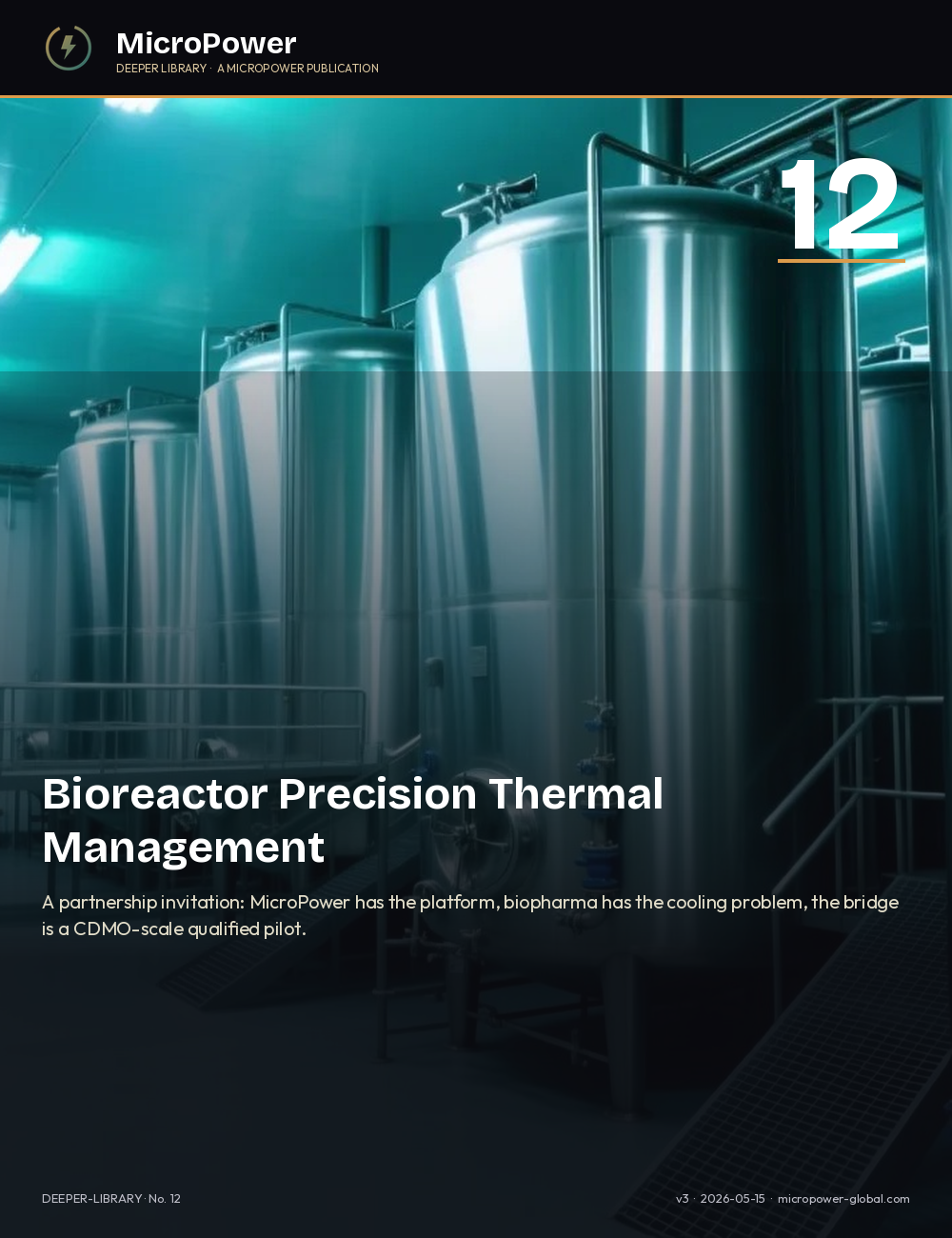
Precision Thermal Management for Next-Generation Bioreactors
Full analysis of bioreactor thermal-control economics, the lab evidence base, four application tiers, and a three-stage partnership model – plus the regulatory pathway under 21 CFR Part 11 and EMA Annex 11.
Related Sectors
Bioenergy & Biogas
Thermoelectric exhaust recovery for sub-1 MW biogas CHP, biomass boilers, and pyrolysis – the combustion side of bio.
Industrial Waste Heat
Steel, cement, glass, petrochemicals – including the H₂ DRI green-steel transition.
Defence & Portable Power
Silent, vibration-free power for field operations and remote deployments.