Bioenergy & Biogas
Thermoelectric exhaust recovery for the sub-1 MW tier where Organic Rankine Cycle turbines stop being economic.
The Sub-1 MW Gap
A large, distributed, underserved fleet – with regulatory tailwinds that reward every recovered kWh.
Plus a far larger installed base of sub-MW biogas digesters
~5.2 bcm produced in 2024 – gap requires efficiency gains, not just new build
69 more under construction; 45V now rewards biogas-to-hydrogen
Why the Sub-1 MW Tier Has No Incumbent
Organic Rankine Cycle economics do not scale down
The ORC Economics Problem
Above roughly 1 MWe, Organic Rankine Cycle (ORC) turbines are the proven incumbent at 300–450°C – and remain the right answer at that scale. Below 1 MWe the fixed cost of expanders, seal systems, heat exchangers, and controls does not shrink in proportion to output. Capital intensity per kW rises sharply and rotating-machinery maintenance competes with the site's existing engine service contract.
Most biogas plants in the EU fleet sit between 250 kW and 1 MWe – feedstock availability at farm and municipal scale naturally pushes projects into exactly this band. The practical result: the majority of installed biogas plants have no commercially deployed waste-heat-to-power option today.
The opening for PowerRing: solid-state, modular, wraps the exhaust geometry already on site. No new rotating machinery. No working fluid. No seals.
PowerRing on Biogas CHP Exhaust
Geometry, temperature, and maintenance profile all align
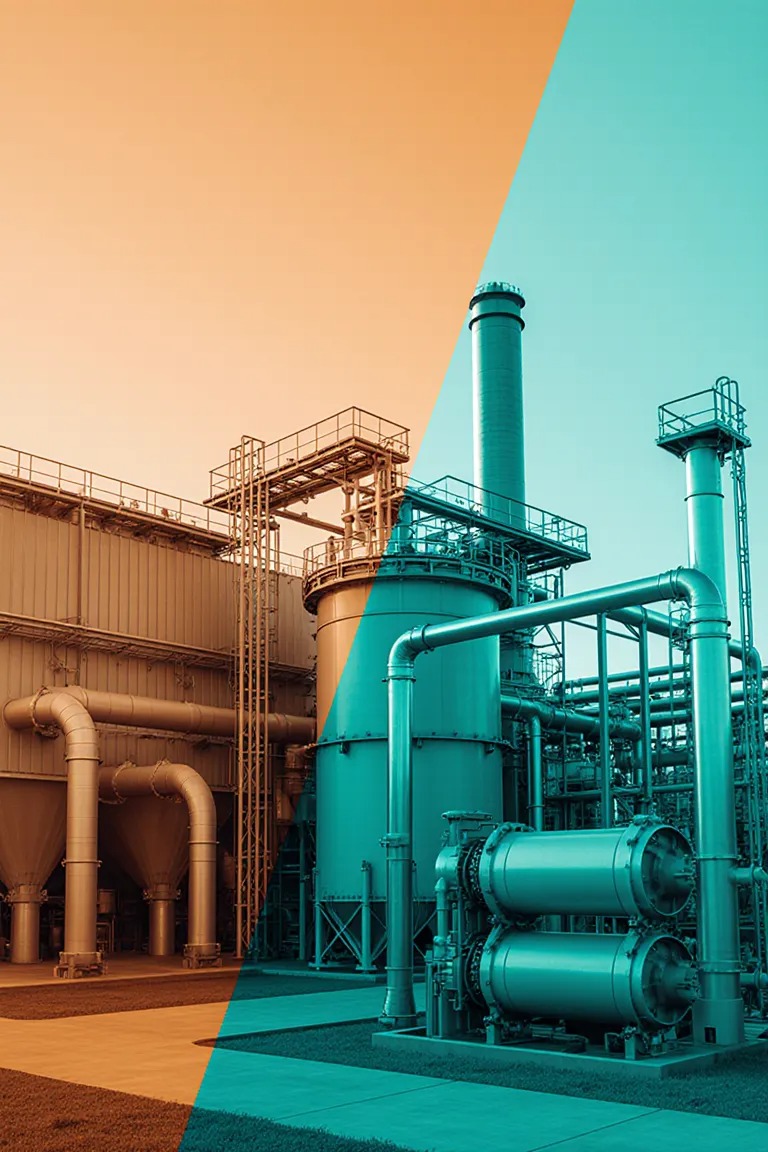
Geometry-Matched Integration
The PowerRing wraps around exhaust pipes – the same geometry present on every biogas CHP engine installation. A retrofit path with minimal structural modification.
Temperature Sweet Spot
MicroPower's PbTe / TAGS modules operate across 300–1,000°C. Biogas CHP engines typically run exhaust at ~450°C at full load, with an operational floor of ~180°C to avoid acid condensation from sulphur in the fuel. A ~277–677°C modelling band covers primary exhaust plus pre-heated and secondary-recovery variants.
Maintenance and Controls Fit
Solid-state, no moving parts, no working fluid, no seals. Behaves electrically – no new mechanical crew required; integrates with the site's existing control system rather than demanding a parallel one.
Exhaust Temperature Profile by Engine Family
Anchored to manufacturer datasheets and independent operational sources
Efficiency – What the Literature Actually Says
We anchor the comparison to peer-reviewed sources rather than a single unsourced figure
Literature Range for Biomass CHP + TEG
Champier (Applied Thermal Engineering, 2017) reviews TEG performance across biomass combustion and reports system-level efficiencies in the 2–5% range with conventional BiTe-based commercial modules at hot-side temperatures typical of wood and pellet boilers. That is the band a technical reviewer will expect to see.
Where PowerRing Changes the Picture
PbTe / TAGS module conversion efficiency in the 300–550°C band reaches approximately 14% at 550°C – a figure extrapolated from the US Army Research Laboratory's evaluation of MicroPower's standard modules, with NREL independently confirming that production modules met datasheet specification. Installed-system numbers will be lower than this module figure; exact uplift depends on cold-side design, contact resistance, and integration quality.
What We Model for Customer Economics
We model a credible system-level efficiency uplift from the 2–5% literature band into a 7–10% band for a well-integrated PowerRing retrofit, rather than quoting a module-versus-system comparison that would overstate the delta. Honesty here protects the sale – DOE and EU programme reviewers test numbers against public literature.
Full-system results will vary by site; request a site-specific modelling exercise via the contact page.
Adjacent Streams: Pyrolysis and Biogas-to-Hydrogen
Two more places where the PowerRing temperature window fits naturally
Commercial Pyrolysis
PYREG, Biomacon, Carbofex and CharTech all operate in the 400–800°C range – entirely inside MicroPower's PbTe / TAGS window. Waste-heat recovery on pyrolysis exhaust is attractive and not yet standard practice, which makes this a greenfield channel with no entrenched incumbent.
- PYREG: ~300 t/yr feedstock per unit; 5+ operating plants
- Biomacon: 140–2,000 t/yr range; multiple installations
- Carbofex: 700 t biochar + 600 t bio-oil/yr
Prior OSPRE bio-waste pyrolysis collaboration provides a credible foundation story.
Biogas-to-Hydrogen (Emerging)
Virginia Tech has published on combined anaerobic digesters and microbial electrolysis cells (MECs). AD + MEC integration lifts methane yield up to 2.3× relative to AD alone, and the MEC's electrical demand can in principle be sourced from the digester's own waste heat via a TEG.
IRA §45V extended biogas-to-hydrogen pathways to up to $3.11/kg of clean hydrogen (final rules Jan 2025), changing the economics materially.
We frame this as an emerging research pathway newly economic under 45V – not a deployed product. Peer-reviewed basis exists; a TEG-powered MEC on a commercial biogas skid has not yet been demonstrated at scale.
Where MicroPower stands today
MicroPower's modules have been proven in proof-of-concept tests in real, high-temperature industrial conditions, and independently validated. What has not yet happened is commercial deployment at scale.
That gap is not about whether the technology works – it does. It is that commercialising it needs a manufacturing capability and the capital to build it, which the company is now working to put in place. The opportunity set out on this page is a near-term target built on that validated platform, not a deployed product today.
Ideal First-Deployment Profile
Anaerobic Digesters
Agricultural and wastewater biogas, 250 kW–1 MWe – exactly the tier ORC cannot economically serve.
Landfill Gas CHP
Caterpillar-heavy fleet in North America; LCFS / D3 RIN economics make incremental efficiency high-value.
Biomass Heat-Only Boilers
PowerRing added as a primary power-generation stage on boilers that currently deliver only heat.
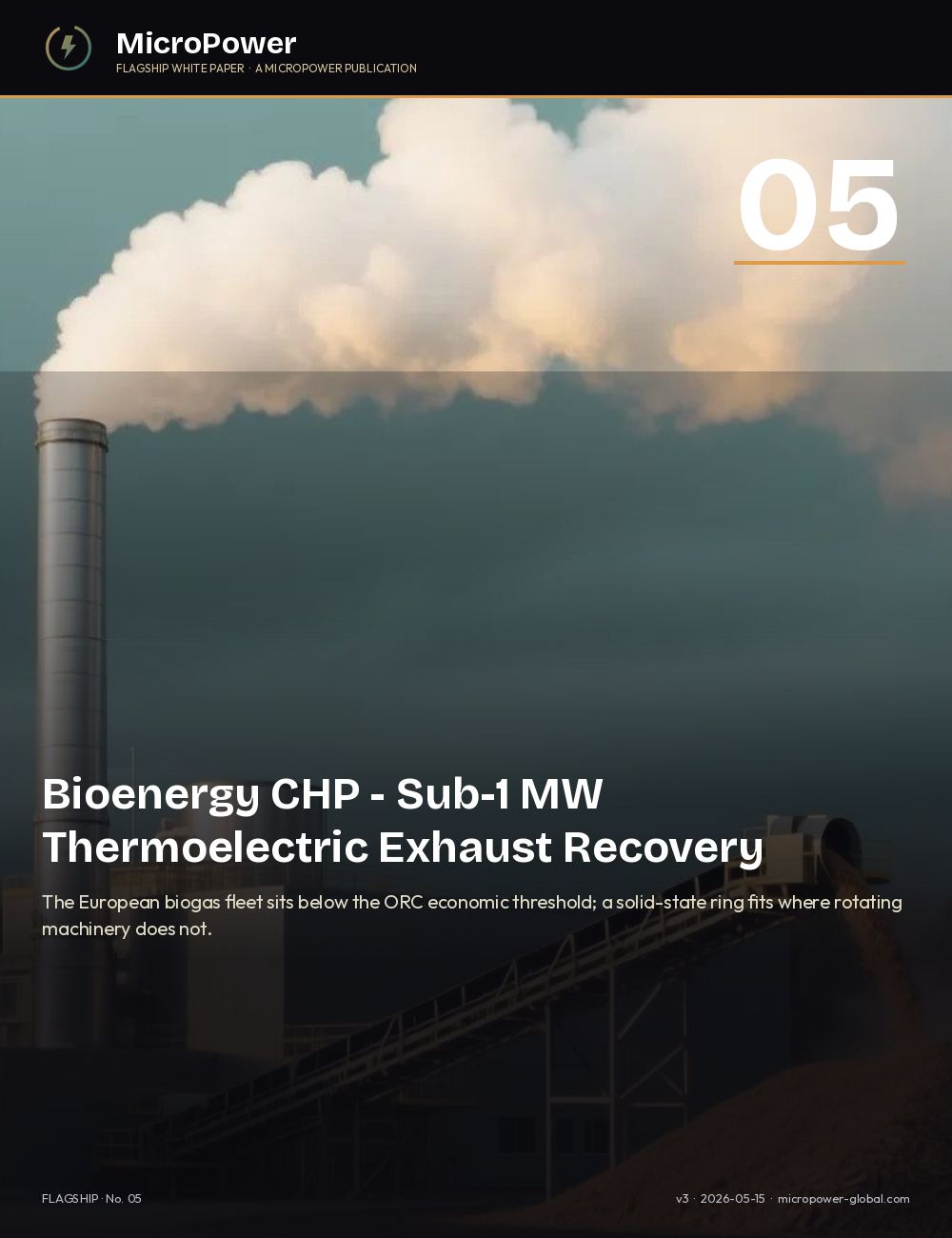
Sub-1 MW Biogas CHP: The Missing Waste-Heat-to-Power Tier
Full sector analysis, engine-level exhaust data, honest efficiency modelling, and the deployment path for first-wave partners. Also covers biomass CHP, pyrolysis adjacencies, and the 45V-enabled biogas-to-hydrogen pathway.
Related Sectors
Bioenergetics & Synbio
Precision thermal management and cryogenic cooling for bioreactors, cell banking, and synthetic biology – the living-systems side of the story.
Industrial Waste Heat
Steel, cement, glass, and petrochemical exhaust streams – including the H₂ DRI green-steel transition.
Emerging Opportunities
Gigafactories, sustainable aviation fuel, direct air capture, and stranded-gas flare mitigation.