Knowledge Centre
Explore our library of white papers, case studies, and technical documentation. Deep-dive into the science, applications, and economics of thermoelectric technology.
Flagship White Papers
Five flagship papers across our priority go-to-market sectors – the current foundation for partner conversations. Each pairs with its sector page, which carries the commercial framing and contact pathway.
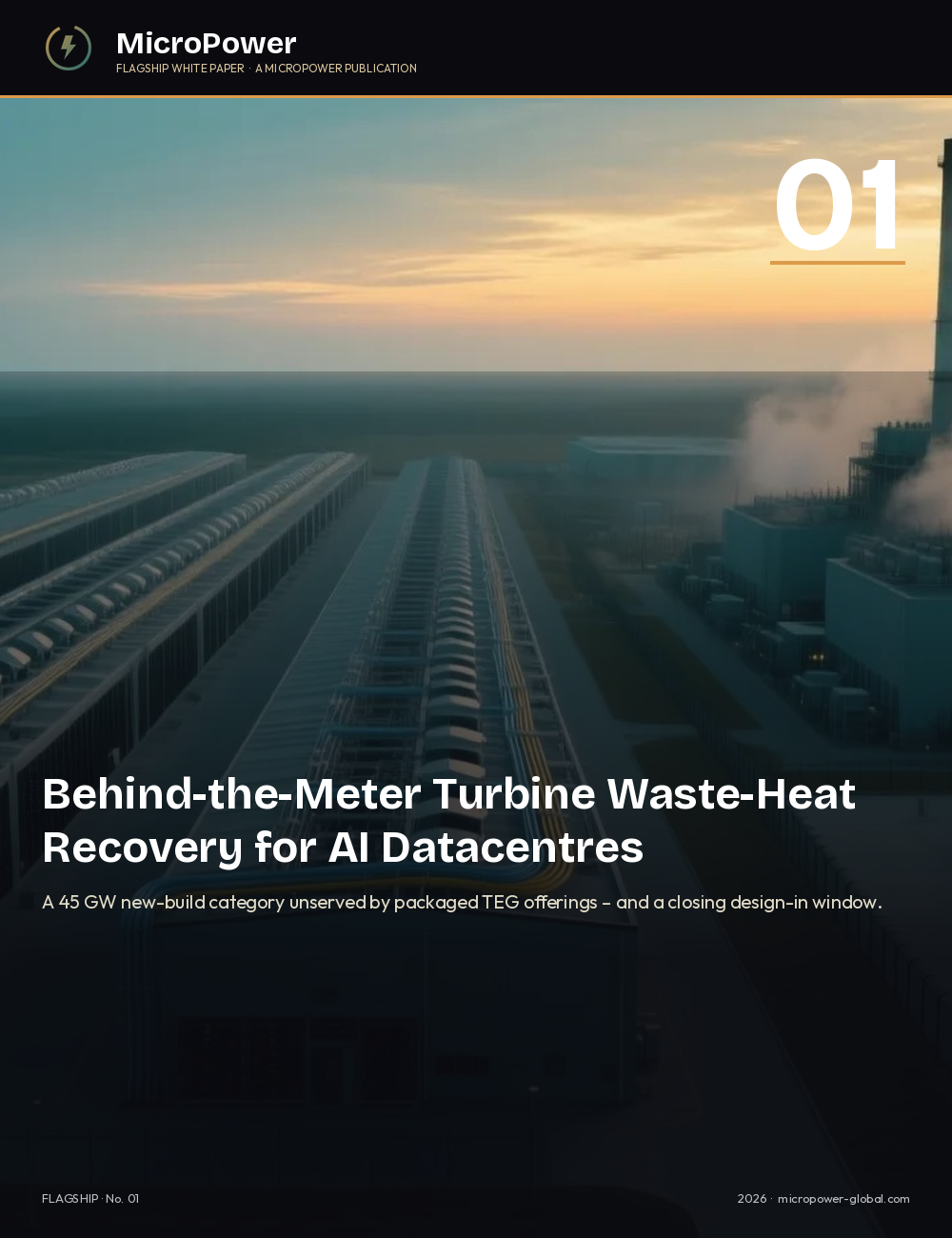
01 · Behind-the-Meter Turbine Waste-Heat Recovery for AI Datacentres
The AI datacentre power crisis has produced a 45 GW+ behind-the-meter gas-generation buildout – every published exhaust-temperature figure for the major aeroderivative, frame, and reciprocating engine families sits inside MicroPower's PbTe / TAGS operating sweet spot, and no commercial TEG offering is currently deployed on a BTM datacentre generator. A closing design-in window through late 2026.
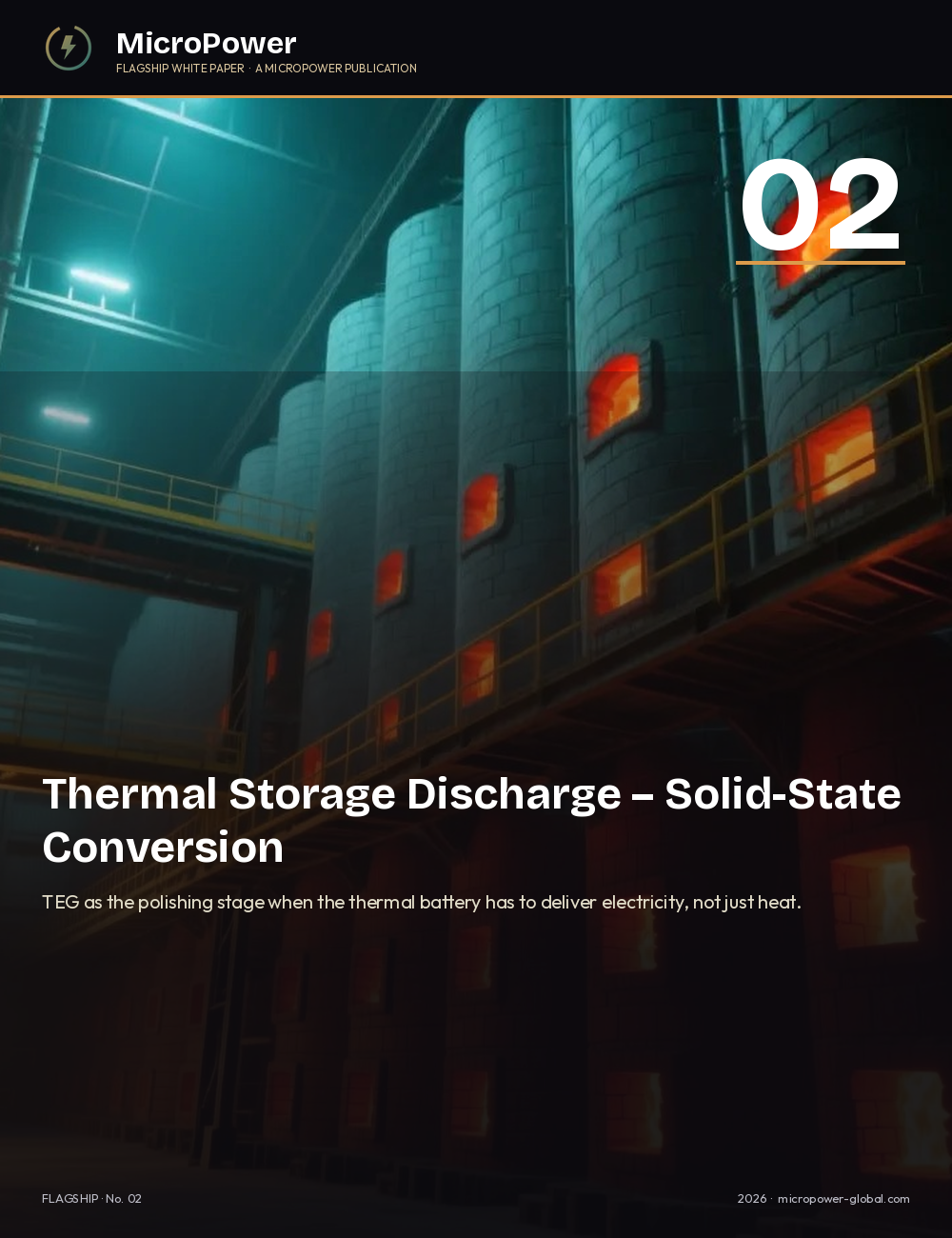
02 · Thermal Energy Storage Discharge
Solid-state discharge of high-temperature thermal energy storage. PbTe / TAGS modules bracket the 300–1,000°C discharge-side window where conventional bismuth-telluride modules cannot operate. Channel-strategy framing of the partner landscape: EPCs, OEMs, and offtakers as engagement priorities, not claimed relationships. Lead architecture: HEX-integrated TEG (modules embedded as the discharge heat-exchanger surface). Secondary: PowerRing retrofit on existing discharge ducts.
Download paper 02 (PDF) See the Thermal Storage sector page →
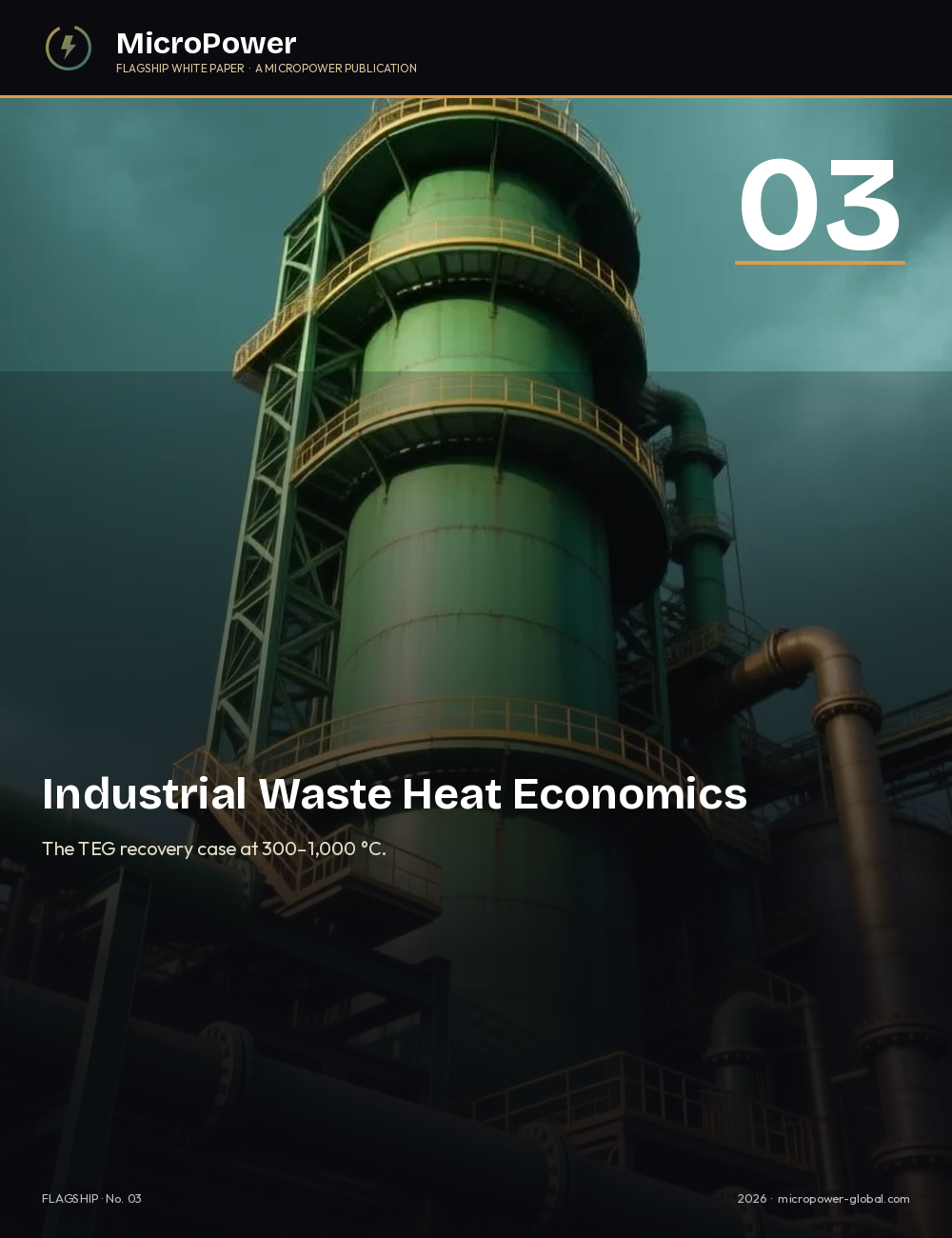
03 · Industrial Waste Heat Economics
The TEG recovery case at 300–1,000°C: steel mill EAF ducts, cement and glass kilns, genset and CHP exhaust. Production-spec module conversion efficiency is 14% at 550°C – extrapolated from ARL's evaluation of MicroPower's standard modules, with NREL independently confirming that production modules met datasheet specification. Real reference applications: CS-A Gerdau Manitoba (2,500+ hours of validated runtime) and CS-C BrasilGTW (engineered, did not deploy).
Download paper 03 (PDF) See the Industrial Waste Heat sector page →
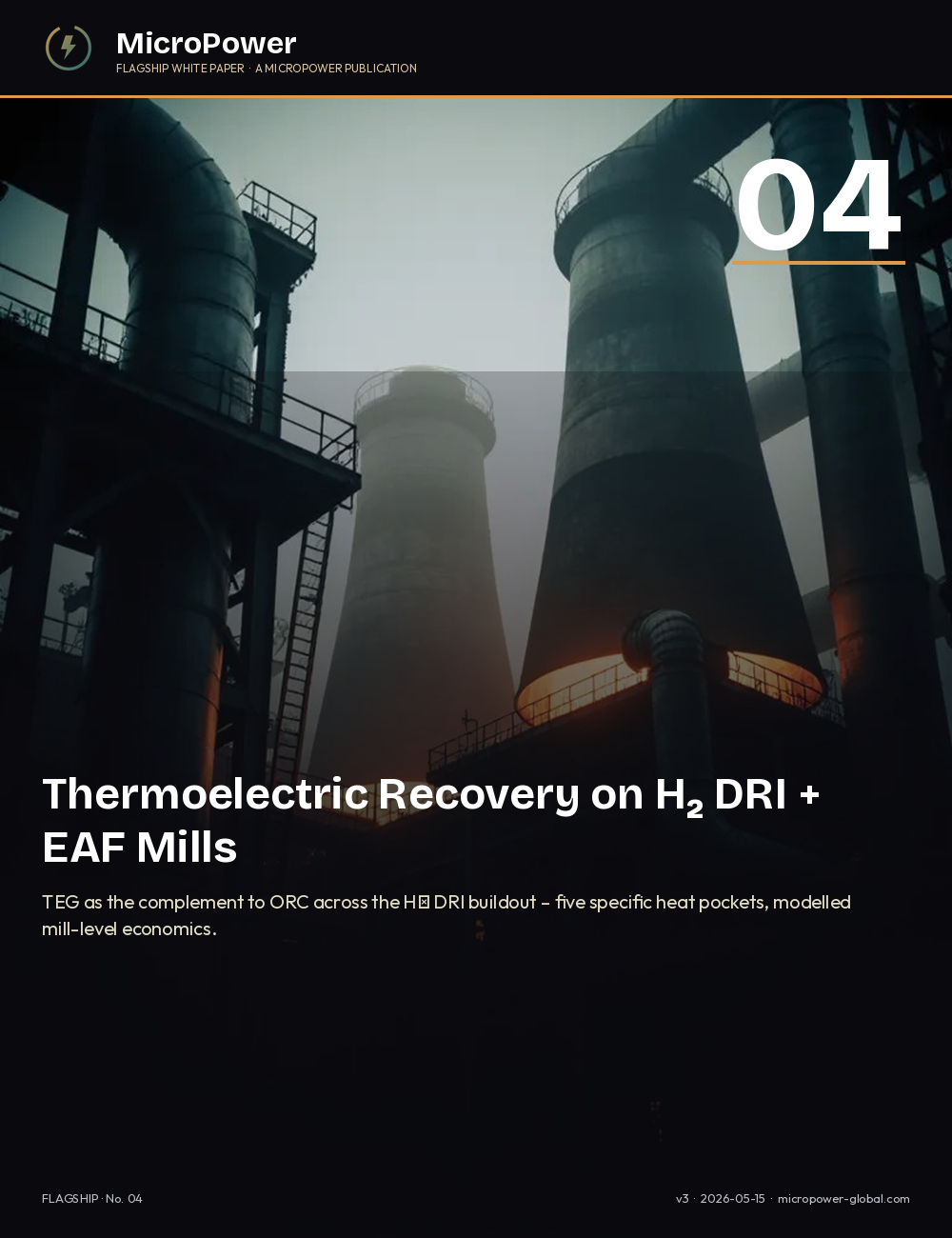
04 · H₂ DRI Steel Recovery
Two pathways for steel. Hydrogen-based direct reduced iron (H₂-DRI) is the European decarbonisation route, with a 2026–2028 design-in window open on off-gas and ancillary heat streams inside MicroPower's chip envelope. BF-BOF retrofit on the global installed base covers hot stove flue gas, slag granulation, BOF off-gas tail, and coke-oven WHB tail. Engagement model targets DRI OEMs (Midrex, Tenova Energiron, Primetals), EPCs, and mill owner-operators on first-deployment integration.
Download paper 04 (PDF) See the Industrial Waste Heat sector page →
05 · Bioenergy CHP – Sub-1 MW Thermoelectric Exhaust Recovery
The European biogas fleet of 1,600+ biomethane plants and tens of thousands of digesters sits below the ORC economic threshold. PowerRing wraps the exhaust pipe geometry already present on every gas engine, has no moving parts, and operates in MicroPower's 300–1,000°C sweet spot. Worked example at 500 kWe digester scale, sized against REPowerEU, RED III, IRA 45V, and LCFS revenue.
Deeper Library
Capability notes and adjacency papers covering the rest of the platform – dual-mode reference, sub-cryogenic cooling, CSP, downhole electronics, pyrolysis, PV / TEG hybrid, and bioreactor thermal management. Each is grounded in a primary-source MicroPower document and corrected to current chip-platform performance.
06 · Dual-Mode Platform – One Chip, Power and Cooling
The single-document reference for the underlying chip architecture. The same MicroPower chip runs Seebeck (heat-to-power) and Peltier (driven cooling) modes; production-spec performance is 14% module-level efficiency at 550°C. Real product portfolio: Base Module 3 W / PowerRing 10–50 W / PowerBlock 10–200 W. The MBE-grown energy-sorting barrier-layer architecture is on the post-funding roadmap, not in production-spec modules today.
07 · Sub-Cryogenic Peltier Cooling – Capability Note
A multi-stage laboratory cascade demonstration on a pre-MicroPower (predecessor-company) material system reached cold-side temperatures below −150°C. Bounded performance envelope: short-duration laboratory characterisation, no field-validated COP, no commercial-scale cryostat product. The cryogenic envelope is a development direction reachable from the same platform that powers MicroPower's current waste-heat and high-temperature cooling work.
08 · Concentrated Solar Power – Solid-State Conversion
Dish-concentrated solar receivers operate at 500–800°C – well above the 250°C ceiling of commercial bismuth-telluride modules and inside MicroPower's 300–1,000°C envelope. A solid-state thermoelectric conversion stage at the receiver is mechanically simpler than dish-Stirling and avoids ORC working-fluid complexity. Best developed as a co-engineering project with a dish-integrator partner.
Download paper 08 (PDF) See the Emerging Applications page →
09 · Downhole Drilling Electronics – High-Temperature Peltier
BHA electronics in modern directional drilling sit at downhole temperatures that destroy commercial bismuth-telluride Peltier coolers above ~200°C. MicroPower's high-temperature Peltier modules – the cooling-mode operation of the same chip platform used for power generation – extend the time window during which downhole electronics remain inside their existing thermal rating, by actively rejecting heat from the electronics package despite ambient drill-head temperatures that would otherwise saturate passive thermal design within minutes. This is a time-on-target extension, not a rating extension.

10 · Pyrolysis / Biochar TEG – Reactor Wall Recovery
Biomass pyrolysis reactors operate at 400–700°C and continuously reject heat through cooling jackets – squarely inside MicroPower's chip envelope. PowerBlock or PowerRing modules mounted on or around the reactor wall capture rejected heat as electricity. The economic case is set by reactor duty cycle, avoided cost of grid or genset electricity, and any biochar carbon-credit revenue stream.
11 · PV / TEG Hybrid
A thermoelectric layer behind a PV stack is only worth engineering when the back-side temperature is in MicroPower's envelope. Two conditions make the hybrid worth pursuing: concentrator photovoltaics (CPV), or a back-side thermal coupling that holds the TEG hot side in the 300–1,000°C operating window. Outside those geometries, the engineering case is hard to close.
Download paper 11 (PDF) See the Emerging Applications page →
12 · Bioreactor Precision Thermal Management – Partnership Invitation
Biopharmaceutical and synthetic-biology manufacturing rests on tight thermal control. MicroPower's thermoelectric platform has the module-level capability; biomanufacturing has the thermal-control problem; the bridge – a qualified pilot at process-development scale – has not yet been built. No production-scale BiTe cooling demonstration on a bioreactor exists today.
Download paper 12 (PDF) See the Bioenergetics & Synbio page →
Case Studies
Four real-customer case studies, each drawn directly from MicroPower's primary-source pilot and audit documents. No invented kW outputs, no fabricated forward commercialisation – just what the field data and the customer engineering dialogue actually say.
CS-A · Gerdau Manitoba – 2,500 Hours of Cooling-Duct Data
Two PowerBlock installations in the EAF cooling duct at Gerdau Selkirk, Manitoba – July 2021 through September 2022. Temperature range 420–460°C at 40% duty cycle; over 2,500 analysed hours; voltage data consistent with module performance expectations. The longest-running MicroPower field pilot on an operating steel mill.
Download CS-A (PDF) See the Industrial Waste Heat sector page →
CS-B · CMC Steel Texas – 112.5 GWh/Year Waste-Heat Opportunity
An energy-balance audit at the CMC Seguin mini-mill quantifies the waste heat rejected into cooling ductwork at 16.7 MW average, 112.5 kWh per ton of liquid steel, 112.5 GWh per year at a single 1 Mt site. Scaled across CMC's 6 Mt global fleet, a 50% recovery amounts to ~66 GWh annually. The clearest single-document case for thermoelectric EAF retrofit.
Download CS-B (PDF) See the Industrial Waste Heat sector page →
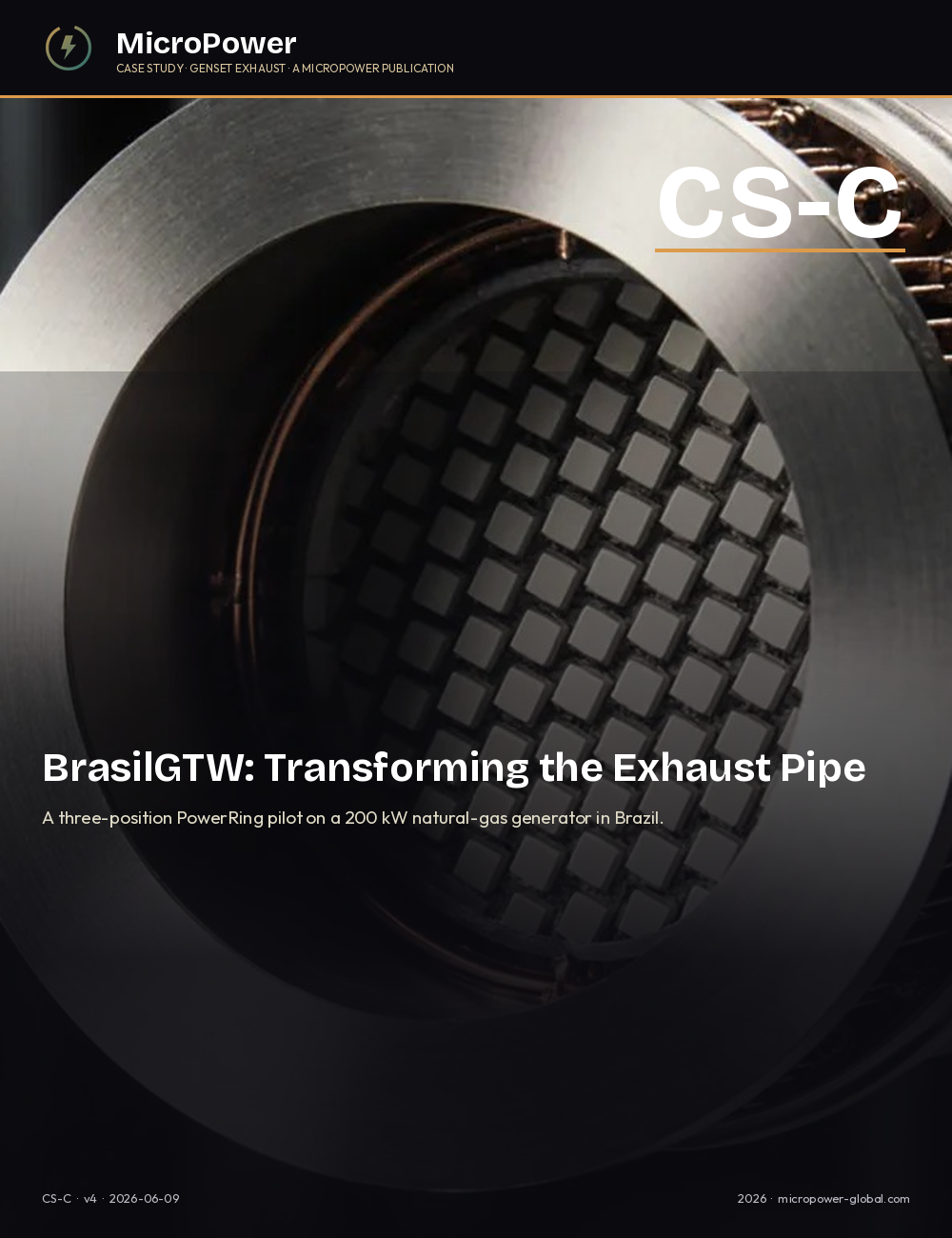
CS-C · BrasilGTW – Transforming the Exhaust Pipe
The first real PowerRing field pilot. Three PR175 positions wrapping the exhaust pipe of a BrasilGTW 200 kW natural-gas generator, November 2020. Staged installation – blank → partial → full population – with in-host fabrication by the BrasilGTW engineering team. Validates the pipe-wrap architecture and the collaborative-fabrication engagement model.
CS-D · ArcelorMittal Dofasco – A Steel-Sector Pilot
The MicroPower waste-heat-recovery pilot at ArcelorMittal Dofasco in Hamilton, Ontario: from the August 2021 phased pilot design through to an initial test unit installed on site and reviewed with the Dofasco engineering team as a successful initial phase. Includes the standardised four-phase pilot methodology – thermal profiling → partial population → optimal population → replication – that MicroPower carries into every steel-industry engagement.
Download CS-D (PDF) See the Industrial Waste Heat sector page →