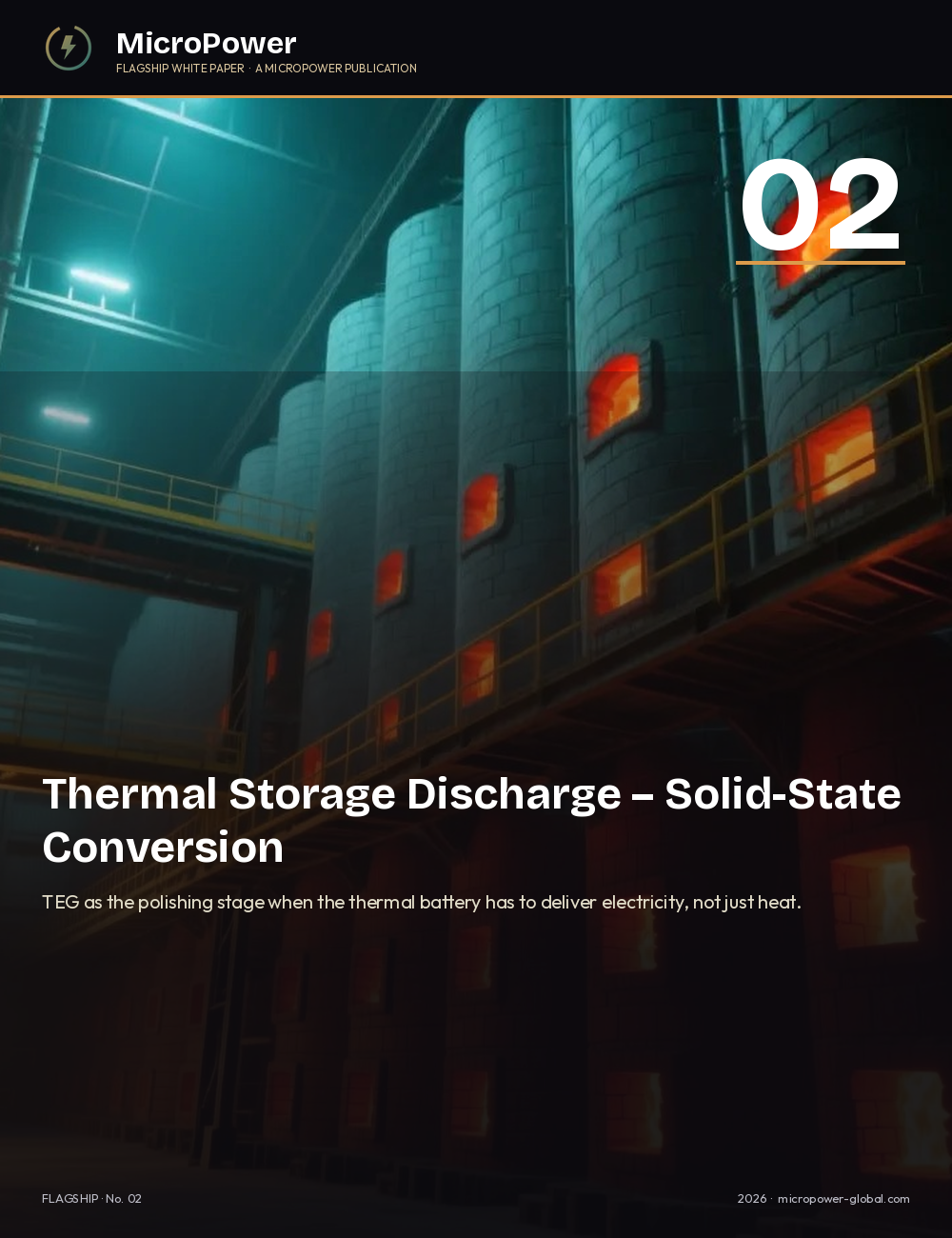
Thermal Storage Discharge
Solid-state power conversion for the high-temperature thermal battery fleet – complementary to steam Rankine, sCO₂ and TPV, and without the water, rotating machinery or minimum viable scale
Why it matters
Thermal batteries store cheap renewable electricity as heat. Turning that heat back into electricity usually requires turbines, working fluids, water and the maintenance that goes with rotating machinery.
MicroPower's role here is not to replace every converter, but to add a solid-state conversion layer where conventional machinery is too large, too wet, or too complex – sub-MW projects, water-constrained sites, and high-temperature media where ORC and steam Rankine struggle.
The Thermal Battery Category Has Arrived
From lab benches to named, financed, utility-scale commercial projects in five years
Announced thermal-battery capacity across Rondo, Antora, E-ThOS, Kyoto, MGA, Fourth Power and others
Molten salt, crushed rock, MGA alloy, refractory brick, molten silicon, carbon block, molten tin
An order of magnitude below equivalent battery electrical storage for the same duration
Heat Out Is Easy. Power Out Is Harder.
The gap in the thermal battery stack
For process-heat customers – steam, hot air, direct radiant – thermal batteries are already solved. Insulation controls losses, a blower or heat exchanger does the rest. But a growing share of developers need to deliver electricity back to the grid or behind-the-meter load, either for peak arbitrage or because the anchor offtaker is an IPP.
Each conventional conversion option imposes real constraints:
- Steam Rankine: Efficient above 10 MWe, but requires water, condensers, and turbine maintenance – a heavy overlay on an otherwise solid, silent thermal core.
- Supercritical CO₂: High efficiency at high temperature, but turbomachinery is still first-of-a-kind with very few vendors in the 1–10 MWe band.
- Organic Rankine Cycle: Works below 500°C, but economics collapse below 500 kWe and it is ill-suited to 1,000°C+ refractory or carbon systems.
- Thermophotovoltaics: Promising above 1,800°C (Antora, Fourth Power), but still ramping cell yields.
- Stirling engines: Elegant thermodynamics, but the installed base of industrial-grade Stirlings in the 100 kWe–1 MWe band is small and OEM support thin.
Why Thermoelectrics Earn a Seat at This Table
A specific combination of properties that thermal batteries value more than any other application MicroPower addresses
Technical Fit
- Steady discharge profile: Thermal batteries hold near-constant hot-face temperature across most of their curve. TEG output depends on ΔT – and ΔT here is unusually stable.
- No moving parts, no water: Matches the fundamental appeal of a thermal battery – quiet, solid, low-maintenance.
- Temperature fit: PbTe / TAGS modules operate cleanly in the 300–800°C band where molten salt, MGA alloy, and first-stage refractory discharge sit.
- HEX-integrated TEG (lead architecture): TEG modules embedded directly inside the discharge heat exchanger – modules carry both the heat-transfer surface and the electrical output. Higher area-density, higher ΔT, and significantly more power per m² than wrapping a downstream duct. The thermal-battery developer's storage-medium HEX becomes the TEG host.
- PowerRing retrofit (secondary): Where a developer prefers an externally-mounted retrofit on an existing discharge duct, the PowerRing geometry wraps any hot exhaust, steam, or hot-oil duct without bespoke heat-exchanger engineering.
Commercial Fit
- Modular: From single-kWe polishing loads up to multi-MWe arrays. No minimum viable size.
- Cascade-friendly: Extracts electrical work from the tail of a Rankine or sCO₂ cycle without adding a second rotating machine or working fluid.
- Retrofit path: Developers can add TEG to an existing thermal-battery project at the turbine outlet without redesigning the core.
- Permitting: No water rights, no air emissions, no high-pressure mechanical code required.
Material Fit by Storage Medium
Where MicroPower's PbTe and TAGS modules sit on each technology
| Storage Medium | Developer Examples | Discharge to TEG | MicroPower Fit |
|---|---|---|---|
| Molten salt (nitrate) | Kyoto Group, legacy CSP vendors | 250–400°C | TAGS mid-band |
| MGA alloy | MGA Thermal | 400–600°C | PbTe / TAGS optimal |
| Crushed rock / concrete | Brenmiller bGen, Heatrock | 300–550°C | TAGS – good |
| Molten silicon | 1414 Degrees (SiBox) | 500–800°C secondary loop | PbTe – excellent |
| Refractory brick | Rondo, Electrified Thermal | 500–900°C via HX | PbTe – primary band |
| Carbon block | Antora Energy | TPV primary; TEG tail < 800°C | PbTe – complementary |
| Molten tin + graphite | Fourth Power | TPV primary; residual 400–800°C | PbTe – complementary tail |
Performance Framing – What We Will and Will Not Claim
Thermal battery discharge is a new application for MicroPower; calibrated numbers only
We do not yet have an installed reference at any named developer. What we do have:
- Material-level performance from the Bechtel-Bettis voltage-test validation of MicroPower's PbTe and TAGS modules
- A PowerRing geometry simulated and prototyped for 300–1,000°C exhaust ducts in turbine and engine applications
- HEX-integrated TEG configurations under development for thermal-battery discharge – modules co-engineered as the storage-medium heat exchanger surface
- A deep peer-reviewed literature on thermoelectric generator system-level efficiency at these temperatures (Champier 2017, Rowe's CRC Handbook of Thermoelectrics, Applied Energy)
At 500–800°C hot-side with a 50–80°C cold-side, peer-reviewed full-system electrical efficiency for PbTe-class modules sits in the 5–8% range. On a thermal-battery discharge tail that would otherwise be rejected, that 5–8% is essentially incremental revenue – not a bulk conversion figure, and that is the correct way to size it in the business case.
MicroPower does not quote the 10–15% figures some thermoelectric promotional material circulates; those are module-level, single-ΔT, and do not translate to full-system deployed output. Our commitments are to independently-verified measured performance from each first-deployment pilot.
Where MicroPower stands today
MicroPower's modules have been proven in proof-of-concept tests in real, high-temperature industrial conditions, and independently validated. What has not yet happened is commercial deployment at scale.
That gap is not about whether the technology works – it does. It is that commercialising it needs a manufacturing capability and the capital to build it, which the company is now working to put in place. The opportunity set out on this page is a near-term target built on that validated platform, not a deployed product today.
Flagship White Paper
The full technical and commercial case, 7 pages
WP-B · Thermal Energy Storage Discharge
Developer landscape, storage media temperature profiles, the complementary sCO₂ + Rankine + TPV + TEG stack, an honest performance framing, and go-to-market priorities for the 2026–2027 design-in window.
Related Sectors
Industrial Waste Heat
Steel, cement, glass, refining and hydrogen DRI – the largest stationary waste-heat pools on the planet.
AI Datacentre & BTM Power
Behind-the-meter gas turbine and reciprocating engine exhaust recovery for hyperscaler campuses.
Bioenergy & Biogas
CHP engine exhaust recovery for sub-1 MW anaerobic digestion and biomass sites.