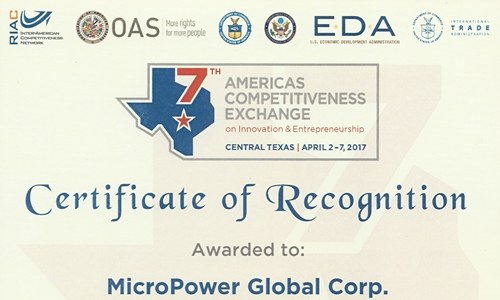
MicroPower was selected as one of a small group of innovative companies showcased to an international delegation visiting San Marcos as part of a U.S. Department of Commerce and State Department initiative.
MicroPower has long supported local economic initiatives in Central Texas and has built a strong working relationship with the Greater San Marcos Partnership (GSMP), the regional economic-development organisation for the City of San Marcos and Hays and Caldwell Counties, in the Innovation Corridor between Austin and San Antonio.
On 5 April 2017, GSMP, the City of San Marcos and Texas State University hosted the 7th Americas Competitiveness Exchange, a global trade and investment initiative led by the U.S. Economic Development Administration and the Organization of American States, bringing together more than 50 leaders from 27 countries. The day-long tour showcased companies representing the area's innovation and entrepreneurship, and MicroPower was selected to take part. The delegation visited MicroPower's facilities and received an overview of its technology and target applications.
"MicroPower is one of our shining stars, an innovative business pushing the boundaries of its industry here in the Innovation Corridor," said Adriana Cruz, President of GSMP.
"We are proud to be part of the San Marcos business community, so it is pleasing to receive this recognition," said Max Lewinsohn, MicroPower's Chairman. "We believe our technology can make a global impact, with our technical base in San Marcos playing a pivotal role in the company's growth."
About MicroPower: MicroPower Global develops advanced thermoelectric generators that convert industrial waste heat into clean electricity. With an international patent portfolio and third-party testing and validation across NREL, the U.S. Army Research Laboratory, NIST, Bechtel-Bettis, and Texas State, MicroPower's technology operates at 3–5× the efficiency of any commercial alternative.